The ultimate guide to rune tattoos: history, meaning, and more

Updated: Jul 1
Rune tattoos carry a unique blend of history, mystery, and personal symbolism. Rooted in ancient Norse and Germanic traditions, runes were more than just an alphabet — they were believed to hold spiritual energy, provide protection, and offer guidance. Today, a rune tattoo is often chosen by people who want their ink to represent strength, destiny, courage, or personal transformation.
But rune tattoos come with responsibility. Unlike a generic tribal band or a floral design, runes carry centuries of cultural weight — and, in some cases, controversial modern associations. This guide will walk you through everything you need to know before getting runic ink, from historical accuracy to safe design choices.
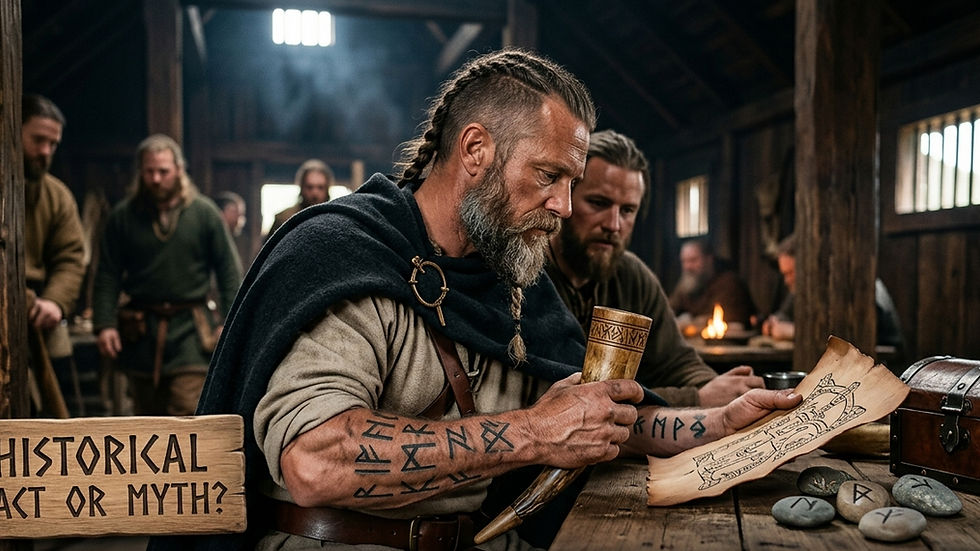
Did Vikings Actually Have Rune Tattoos? History vs. Myth
Short answer: probably not.
Despite the iconic image of a tattooed Viking warrior — runes on his forearms, mystical symbols across his back — there is no solid archaeological evidence that historical Vikings had tattoos. Here’s what we know:
The only source comes from Ahmad ibn Fadlan, a 10th-century Arab traveler who described Rus traders (possibly Scandinavians) as “covered from fingertips to neck with dark green designs.”
However, ibn Fadlan never uses the word “tattoo” in the modern sense. What he saw could have been painted patterns, ritual markings, or traces from dyed clothing — not permanent ink under the skin.
No Norse sagas, skaldic poems, or runestones mention tattooing, despite being full of details about appearance, weapons, and rituals.
No preserved Viking skin with tattoos has ever been found.
Why does the myth persist? Because it feels right. The tattooed Viking has become a modern archetype — raw, wild, and proud. Norse symbols like runes, the Valknut, Yggdrasil, and the Helm of Awe have exploded in tattoo culture. Whether the Vikings used them as body art or not, they remain potent, deeply meaningful symbols in modern ink.
Bottom line: Getting a rune tattoo is a modern practice inspired by ancient symbols. There’s nothing wrong with that — just be honest about it.

Understanding the Futhark: The Runic Alphabets
The most common runic alphabet used in tattoos is the Elder Futhark, a set of 24 characters used from approximately the 2nd to the 8th century CE. Its name comes from the first six runes: F, U, Th, A, R, K.
Here’s a quick breakdown of the main runic systems you’ll encounter:
System | Number of Runes | Time Period | Best For… |
Elder Futhark | 24 | 2nd–8th century CE | Historical accuracy, spiritual and magical meaning |
Younger Futhark | 16 | 8th–12th century CE | Authentic Viking Age inscriptions |
Anglo-Saxon Futhork | 29–33 | 5th–11th century CE | English runic traditions |
Most people choose Elder Futhark because each rune has a well-documented symbolic meaning. However, if you want an inscription that a real Viking would have recognized, use Younger Futhark.
Complete Elder Futhark Rune Meanings (ᚠ to ᛟ)
Below is a comprehensive guide to all 24 Elder Futhark runes. Each entry includes the rune’s name, phonetic value, and primary symbolic meanings — both historical and modern esoteric interpretations.
First Aett: Fehu to Wunjo (ᚠ–ᚹ)
Rune | Name | Meaning | Best for Tattoos Representing… |
ᚠ | Fehu | Wealth, prosperity, abundance — both material and spiritual | Financial success, ambition, fulfillment |
ᚢ | Uruz | Strength, wildness, untamed potential, vitality | Physical and mental strength, health, resilience |
ᚦ | Thurisaz | Protection, defense, Thor's hammer energy | A warrior spirit, safeguarding from harm |
ᚨ | Ansuz | Wisdom, communication, divine inspiration | Intellect, creativity, connection to the divine |
ᚱ | Raidho | Travel, journey, personal growth | Exploration, life path, self-discovery |
ᚲ | Kenaz | Torch, illumination, creativity | Inspiration, knowledge, artistic fire |
ᚷ | Gebo | Gift, partnership, generosity | Love, marriage, balance in relationships |
ᚹ | Wunjo | Joy, harmony, belonging | Happiness, community, emotional well-being |
Second Aett: Hagalaz to Sowilo (ᚺ–ᛊ)
Rune | Name | Meaning | Best for Tattoos Representing… |
ᚺ | Hagalaz | Hail, disruption, necessary change | Transformation through challenge |
ᚾ | Nauthiz | Need, constraint, survival | Perseverance through hardship |
ᛁ | Isa | Ice, stillness, self-control | Patience, clarity, inner focus |
ᛃ | Jera | Harvest, cycles, reward for effort | Long-term goals, patience, karma |
ᛇ | Eihwaz | Yew tree, endurance, connection between worlds | Resilience, spiritual strength, balance |
ᛈ | Perthro | Mystery, fate, hidden things | Intuition, secrets, the unknown |
ᛉ | Algiz | Protection, higher self, divine connection | A shield against harm, spiritual awareness |
ᛊ | Sowilo | Sun, victory, guidance | Personal power, triumph, direction |
Third Aett: Tiwaz to Othala (ᛏ–ᛟ)
Rune | Name | Meaning | Best for Tattoos Representing… |
ᛏ | Tiwaz | Honor, courage, justice, Tyr (the god of law) | Fairness, moral strength, and warrior honor |
ᛒ | Berkano | Birch goddess, growth, new beginnings | Fertility, renewal, and motherhood |
ᛖ | Ehwaz | Horse, trust, teamwork | Partnership, loyalty, and forward movement |
ᛗ | Mannaz | Humanity, the self, community | Personal identity and meaningful social connections |
ᛚ | Laguz | Water, flow, intuition | Emotional balance, healing, and the subconscious |
ᛝ | Ingwaz | Fertility, potential, the hero-god Ing | New beginnings, inner strength, and personal growth |
ᛞ | Dagaz | Dawn, breakthrough, awakening | Positive transformation, clarity, and hope |
ᛟ | Othala | Heritage, ancestry, homeland | Family roots, belonging, and tradition |
Important note: Runes Sowilo (ᛊ), Algiz (ᛉ), Tiwaz (ᛏ), and Othala (ᛟ) appear in the “Controversial Symbols” section below. Their original meanings are beautiful — but modern associations require caution.

Bindrunes: Creating Your Personal Sigil
A bindrune is a combination of two or more runes merged into a single symbol. It’s one of the most meaningful forms of Nordic tattoo work because it creates a design built for you, not pulled from a Pinterest board.
How a Bindrune Works
When you combine runes, the meanings interact. A bindrune can:
Amplify the traits you choose
Balance opposing energies
Carry a narrative or represent a personal transformation
Protect or fortify parts of your life
The magic of a bindrune lies in its unity. It’s not just “Rune A + Rune B” — it becomes something new, woven together into a single symbol with its own identity.
Popular Bindrune Intentions
Intention | Rune Combination | Why It Works |
Strength + Protection | Uruz + Algiz | Rebuilding life after hardship |
Love + Partnership | Gebo + Wunjo | Balance, harmony, and commitment |
Direction + Purpose | Raidho + Sowilo | Embracing a new life path with clarity and confidence |
Healing + Renewal | Laguz + Berkano | Recovering from trauma, grief, or illness |
Courage + Victory | Tiwaz + Sowilo | Facing challenges with determination and achieving success |
Wealth + Strength | Fehu + Uruz | Pursuing prosperity through inner strength and resilience |
Protection + Wisdom | Thurisaz + Ansuz | Combining protection with knowledge, insight, and personal growth |
How to Create Your Own Bindrune
Clarify your intention. What do you want to manifest or strengthen?
Select 2–4 runes whose meanings align with that intention.
Sketch them overlapping. Experiment with stacking, merging, or intertwining.
Refine for visual balance. The design should be aesthetically pleasing and symbolically coherent.
Work with a tattoo artist who understands runic design. Not all artists are equipped to create balanced bindrunes.
Bindrune warning: A poorly designed bindrune may lose its intended symbolism or take on unintended meanings. Don’t rush the process.

Design Styles and Inspiration
Rune tattoos can be adapted to virtually any style. Here are the most common approaches:
Style | Description | Best For… |
Single Rune | Minimalist, clean design featuring a single rune | Small placements such as the wrist or behind the ear |
Bindrune | Multiple runes merged into a single symbol | Personalized meanings and unique storytelling |
Rune Band | Circular arrangement of runes | Symbolizing protection, unity, and wholeness |
Runic Inscription | A word, phrase, or motto written in runes | Honoring a loved one or expressing a personal mantra |
Integrated Design | Runes combined with Norse imagery such as Yggdrasil, Mjölnir, ravens, or wolves | Large tattoos, sleeves, and full compositions |
Traditional / Old School | Bold outlines, black and grey shading, classic runic lettering | A timeless, vintage-inspired aesthetic |
Neo-Traditional | Intricate details, rich shading, and mythological figures | Elaborate, highly artistic tattoo designs |
Color Considerations
While most rune tattoos are done in black ink, some practitioners use specific colors for magical purposes:
Black or dark red — Traditional colors for protective runes
Red — Associated with blood, life force, and sacrifice (historically, runes were sometimes carved in red ochre)

Placement Guide: Where to Put Your Rune Tattoo
Placement affects visibility, pain level, and — for those who believe in runic magic — energetic influence.
Most Popular Placements
Location | Advantages | Considerations |
Forearm | Highly visible, easy to show or hide with sleeves | Classic choice for strength and protection runes |
Upper Arm / Shoulder | Allows for larger designs, easily concealed | Common placement for men's rune tattoos |
Wrist | Subtle reminder of personal intentions | Best suited for small runes; thin skin makes it more painful |
Chest | Personal, impactful, close to the heart | More painful due to proximity to bone |
Back | Spacious area for large compositions | Difficult to see yourself; longer healing time |
Ribcage | Intimate, easily hidden | One of the most painful placements due to thin skin and bone |
Neck | Bold, highly visible statement | May be controversial in professional settings |
Fingers / Hands | Edgy, modern look | Painful and prone to fading because of constant friction |
Energetic Placement (for Magical Practitioners)
If you believe runes carry spiritual energy, placement matters:
Dominant hand — For projecting energy outward (action, manifestation)
Non-dominant hand — For receiving energy (intuition, wisdom)
Over the heart — For influencing emotions and inner strength
On or near an ailment — For healing intentions

Pain and Aftercare: What to Expect
Pain Levels by Placement
Pain Level | Locations |
Low | Outer bicep, forearm, thigh, calf |
Medium | Upper arm, shoulder, back, chest |
High | Ribcage, sternum, armpit, inner thigh, neck |
Very High | Hands, fingers, feet, head/scalp, elbows, knees |
General rule: Bony areas with thin skin hurt the most. Areas with more muscle or fat are easier.
Aftercare Essentials
Keep it clean. Wash gently with unscented antibacterial soap.
Moisturize. Apply a thin layer of tattoo-specific ointment or unscented lotion.
No soaking. Avoid pools, hot tubs, and long baths for at least 2–3 weeks.
No direct sunlight. UV rays fade rune tattoos quickly. Use SPF 30+ once healed.
No scratching. Peeling is normal — don’t pick.
Listen to your artist. Every tattooer has slightly different aftercare protocols.
Controversial Symbols: What to Avoid and Why
This is the most important section of this guide — and the one most other articles gloss over. The problem: Over the last 120 years, certain runes and Norse symbols have been co-opted by neo-Nazis and white supremacist groups. While their original meanings are beautiful and sacred, their modern associations can cause serious misunderstandings — or worse, make you appear to support hate.
Runes That Require Extreme Caution
Rune / Symbol | Original Meaning | Modern Problem |
Sigel / Sowilo (ᛊ) | Sun, victory, guidance | Can resemble the Nazi SS lightning-bolt insignia; the doubled SS symbol is a recognized hate symbol |
Eihwaz (ᛇ) | Yew tree, endurance, connection between worlds | Has been appropriated by some extremist groups because of its associations with death and the afterlife |
Tyr / Tiwaz (ᛏ) | Honor, courage, justice, the god Tyr | Has been co-opted by some white supremacist groups as a symbol of "racial justice" |
Odal / Othala (ᛟ) | Heritage, ancestry, homeland | Sometimes associated with Nazi "Blut und Boden" ("blood and soil") ideology and modern extremist movements |
Algiz (ᛉ) | Protection, higher self, divine connection | An inverted or modified version has been used by some extremist organizations, creating potential confusion |
Valknut | Three interlocking triangles associated with Odin and the afterlife | Sometimes appropriated by hate groups promoting a distorted version of Norse symbolism |
Black Sun (Sonnenrad) | No historical runic meaning | A modern symbol created and popularized by the Nazis; widely recognized as an extremist symbol and best avoided |
What About Thor’s Hammer (Mjölnir)?
Thor’s hammer is extremely popular — but it has also been adopted by white supremacist and outlaw biker groups. If you choose a Mjölnir tattoo, consider adding a depiction of Thor himself or other clarifying elements to signal that your intent is mythological, not political.
How to Safely Use These Symbols
If you genuinely connect with the original meaning of a controversial rune, here’s how to avoid misinterpretation:
Research thoroughly. Understand both the historical meaning and the modern baggage.
Combine with clarifying elements. Add Thor, Yggdrasil, or other clearly Norse imagery.
Be prepared to explain. If someone asks, you should be able to articulate your intent.
Consider placement. A visible neck or forearm tattoo of Othala will raise eyebrows. A chest piece may not.
Bottom line: The runes themselves are not racist. They were alphabets used for everything from gravestones to trade marks. But misuse by extremists means you must be aware of context before you ink.

Common Mistakes That Can Ruin Your Rune Tattoo
Here are the most frequent errors people make — and how to avoid them.
Mistake 1: Choosing a Rune Just Because It “Looks Cool”
Each rune has a specific meaning. Some are positive (Fehu = wealth). Others are challenging (Hagalaz = disruption, Nauthiz = need).
Solution: Research the meaning of every rune you consider. Make sure it aligns with what you actually want to represent.
Mistake 2: Letter-by-Letter Translation
Runes represent sounds, not direct letter equivalents. Translating your name letter-by-letter often produces gibberish or unintended meanings.
Solution: Consult a runic translator or someone knowledgeable in Old Norse phonetics.
Mistake 3: Mixing Different Futharks
Elder Futhark and Younger Futhark are different alphabets. Mixing them in one design is historically inaccurate and looks odd to anyone who knows runes.
Solution: Pick one system and stick with it.
Mistake 4: Using Unreliable Internet Sources
Many online rune charts are inaccurate. Some “meanings” were invented in the 1970s by occult authors, not based on historical sources.
Solution: Cross-check meanings from multiple academic or established runic sources.
Mistake 5: Rushing a Bindrune Design
A poorly constructed bindrune can lose its intended meaning or — in esoteric practice — attract unintended energies.
Solution: Take your time. Sketch multiple versions. Work with someone who understands bindrune construction.
Mistake 6: Ignoring Modern Political Baggage
Getting a historically accurate rune tattoo is great — but if that rune has been co-opted by hate groups, you may be sending a message you don’t intend.
Solution: Read Section 9 of this guide.
Mistake 7: Getting a Tattoo in a Language You Don’t Speak
If you’re inscribing an Old Norse phrase, make sure you know what it actually says — not just what Google Translate tells you.
Solution: Consult an Old Norse scholar or a reliable academic source.

Recommended Resources: Books and Artists
Books
Title | Author | Best For… |
Protective Runic Staves | RunicHub (Digital) | A practical guide to 10 unique staves for protecting relationships, the home, personal energy, and well-being, with step-by-step activation instructions. An excellent choice for personal protection work. |
Rune Action Guide | RunicHub (Digital) | A 122-page mobile-friendly guide with five dedicated pages for each rune. Ideal for in-depth interpretation and daily rune practice. |
Runes, Sigils & Bindrunes | Northern Black & Peter Oakmund Madsen | Suitable for both beginners and experienced practitioners, bridging ancient runic traditions with modern magical practice. |
Viking Tattoos: Nordic and Norse Pagan Symbols of Spirituality | Matthew Leigh Embleton | Explores Norse symbols for tattoos and personal talismans while discussing their historical context and modern misuse. |
Norse Symbols: Compact and Well-Founded | — | Explains how Viking symbols were used on the body, on rune stones, and on ships, with a strong historical focus. |
Mythical and Spiritual Tattoo Design Directory | Chartwell Books | A comprehensive reference for tattoo artists and anyone seeking inspiration for mythological and spiritual tattoo designs. |
Finding a Tattoo Artist
Not all tattoo artists understand runes. Here’s how to find a good one:
Look for specialization in Nordic, Norse, or runic work.
Check their portfolio for clean lines and historically informed designs.
Ask about bindrunes. A good artist will work with you to create something meaningful, not just copy an image.
Consider artists in Scandinavia (or those trained in Nordic tattoo traditions) if you want maximum authenticity.
Frequently Asked Questions (FAQ)
Is it safe to get a rune tattoo?
Yes — runes themselves are just symbols. The safety concerns are about meaning (choosing a symbol that aligns with your values) and social context (avoiding runes co-opted by hate groups).
Which runes should I absolutely avoid?
Avoid runes that have been heavily co-opted by neo-Nazis: the SS-style Sowilo (doubled), the winged Odal, the Wolfsangel, and the Black Sun. Use extreme caution with Sowilo, Eihwaz, Tiwaz, Othala, Algiz, and the Valknut.
Can I combine runes from different Futharks?
Technically yes, but it’s historically inaccurate and may look strange to those who know runes. Stick to one system.
What’s the difference between Elder and Younger Futhark?
Elder Futhark (24 runes) is older (2nd–8th century) and more common for magical/spiritual meanings. Younger Futhark (16 runes) is what actual Vikings used during the Viking Age.
Is it disrespectful to get a rune tattoo if I’m not Scandinavian?
Most modern practitioners agree that runes are for anyone who approaches them with respect and a desire for genuine understanding. However, some people of Scandinavian descent may feel differently. The key is respect, research, and intentionality — not superficial “cool factor.”
Can rune tattoos be removed?
Yes, but removal is expensive ($200–$500 per session, 6–12 sessions typically), painful, and not always complete.
How painful is a rune tattoo?
Pain depends on placement. Forearm or outer bicep = low pain. Ribcage, sternum, or neck = high pain.
What if I already have a controversial rune tattoo?
Options include: laser removal, cover-up with a new design, or — if the rune was chosen with pure intentions — keeping it but being prepared to explain its true meaning to anyone who asks.
Can I design my own bindrune?
Absolutely — in fact, that’s the most meaningful approach. Just make sure you understand each rune’s meaning and how they interact. Work with a knowledgeable artist to ensure the design is balanced and coherent.
Did Vikings really have rune tattoos?
Probably not. There’s no archaeological evidence, and the only historical account (ibn Fadlan) is ambiguous. The tattooed Viking is largely a modern myth — but that doesn’t make rune tattoos any less meaningful as modern symbols of personal strength and heritage.
What’s the best placement for a protection rune?
Common choices: forearm (visible shield), chest (close to the heart), or over the heart (for emotional protection). Some practitioners place Algiz on the non-dominant hand for receiving protective energy.
Can I get a rune tattoo in color?
Yes, but most traditional rune tattoos are black ink. Some magical practitioners use red for life-force energy or black/dark red for protective runes.


Comments