Ehwaz rune meaning – the Trusty Steed of Partnership & Progress

Updated: Dec 8, 2025
Ehwaz is the nineteenth rune of the Elder Futhark, embodying the energy of the horse – forward movement born from trust and cooperation. Upright, it carries you toward steady progress, harmonious teamwork, and positive change; reversed, it warns of stalled journeys, discord, or mistrust hindering your path. In essence, Ehwaz harnesses the power of partnership in motion – the loyal steed and rider working as one toward a shared goal.

Ehwaz rune overview and correspondences
Aliases: Ehwaz, Eh (Anglo-Saxon Futhorc) – (ᛖ) Futhark: Elder Futhark (Rune 19/24; 3rd rune of Tyr’s Ætt) Phoneme: /e/ (as in “energy”; pronounced “AY-waz”) Literal Meaning: “Horse” – by extension, movement, transportation, partnership Core Themes: Steady progress, trust between partners, cooperative action, adaptability
Aspect | Correspondence |
Name Variants | Ehwaz (Proto-Germanic), Eh or Eōh (Old English Anglo-Saxon – spelled “Eh” to avoid confusion with Ēoh ᛇ “yew”). |
Meaning | “Horse” → symbol of movement, travel, and loyal partnership. Signifies progress through cooperation and trust. |
Phonetic Value | E (as in “every” or “ay”) – represents the “eh” sound. |
Position | 19th rune of Elder Futhark; 3rd rune of the third ætt (Tyr’s Ætt). In Anglo-Saxon Futhorc, it appears as ᛖ Eh. (The Younger Futhark dropped this rune, having no dedicated E rune.) |
Element | Earth (stability, grounded effort) with an undertone of Air (movement, travel). |
Associated Deities | Freyja and Freyr – twin Vanir gods of fertility and harmony, reflecting Ehwaz’s themes of partnership and fruitful cooperation. (In myth, Odin’s magical horse Sleipnir is also linked to Ehwaz’s energy of travel between worlds – more on this later.) |
Keywords | Partnership, cooperation, trust, loyalty, movement, progress, journey, adaptability, harmony, “two working as one.” |
Color | White (purity of intent, mutual trust); Green (growth and forward momentum). |
Animals | Horse (especially a warhorse or steed – symbolizing loyal service and travel). Ehwaz’s rune shape (ᛖ) even resembles two horses or a horse and rider in sync. |
Stones | Calcite; Sapphire – promoting clarity, loyalty, and balanced progress. |
Herbs/Scents | Ragwort; St. John’s Wort – plants tied to safe travels and easing restlessness (St. John’s Wort is a traditional herb for anxiety, fitting Ehwaz’s calming of the “restless” rider). |
Affirmation | “I move forward steadily, trusting the journey and those by my side.” |
Etymology & Historical Note: Ehwaz is a reconstructed Proto-Germanic word meaning “horse,” cognate to Latin equus and Old Irish ech. This rune’s name survived into the Anglo-Saxon Futhorc as Eh (also called Eoh), carrying the same meaning of “horse.” (Anglo-Saxon scribes deliberately spelled it Eh to distinguish it from a different rune Ēoh ᛇ meaning “yew tree”, which sounds similar.) In the later Younger Futhark of the Viking Age, Ehwaz was not retained – the Norse reduced their rune set and had no separate symbol for the e sound, so Ehwaz’s sound value merged with other vowels.
Visual form: The shape of ᛖ is often likened to an “M” or to two horses standing face to face. In esoteric interpretation, the rune’s form suggests dual forces in harmony – such as a horse and rider moving together, or a pair of allied horses pulling a chariot. Indeed, one commentary notes that Ehwaz “consists of two elements that symbolize not only loyalty but also the existing trust between the horse and its rider,” foreshadowing “harmonious cooperation of two forces aiming to achieve the same goal”. This reflects the rune’s core idea: synergy and partnership make progress possible.
Anglo-Saxon Rune Poem: The Anglo-Saxon Rune Poem provides a historical glimpse of Ehwaz’s significance. Its verse for Eh (horse) praises the animal’s value to lords and wanderers:
The horse is a joy to princes in the presence of warriors,a steed proud in its hooves, when rich men on horseback exchange speech about it;and it is ever a source of comfort to the restless.
In these lines, the horse is depicted as a noble companion that brings joy and solace – themes of nobility, companionship, and relief from restlessness that echo Ehwaz’s meaning in divination. The horse’s ability to carry one swiftly to far-off places made it invaluable and even sacred in early Germanic culture (Germanic tribes used horses for divination and revered them as divine messengers, according to Tacitus). Ehwaz encapsulates this reverence, standing for the idea that with a trusted partner (or mount), no distance is too great and no burden too heavy.

Divinatory meanings of Ehwaz
In rune divination, Ehwaz often signals movement and cooperation. It indicates that progress is achieved through partnership – be it between people, between one’s conscious and subconscious mind, or even between a person and the tools/animals they rely on. When Ehwaz appears, it usually suggests that you are (or need to be) “on the same wavelength” with someone or something to reach your goal. It can literally mean a journey is underway, or metaphorically point to personal growth and transitions that require trust and collaboration.
Ehwaz is generally a positive, forward-driving rune. It “strengthens the other runes in a spread, amplifying their meanings with its dynamic energy” – acting like a cooperative force multiplier. However, like all runes, it has a balanced meaning and a “shadow” side when reversed. Below we explore Ehwaz’s interpretations in readings, both upright and reversed:
Upright Ehwaz (ᛖ) – “Harmonious Progress”
Essence: When Ehwaz appears upright, it heralds forward momentum through teamwork. It signifies that steady, positive change is happening or is about to happen, fueled by trust, loyalty, and cooperation. Just as a rider and horse must work together, an upright Ehwaz indicates that working in sync with others (or aligning the different parts of yourself) is the key to success now. Progress may be gradual but will be reliable and sustained. There is a sense of harmony in movement – things are “clicking” because everyone (or every part of you) is moving in the same direction. Often, Ehwaz upright can literally foreshadow a trip, move, or new mode of transportation (e.g. getting a new vehicle), especially if the question is about travel or relocation. More broadly, it emphasizes partnerships and trust as the vehicle for advancement.
Life Domains – Upright Ehwaz:
Love & Relationships: A partnership is growing stronger or moving to the next level. There is mutual trust, understanding, and teamwork in your relationship. Ehwaz upright can even indicate a marriage or formal partnership on the horizon (it’s an excellent sign of people coming together with a shared vision). If single, Ehwaz suggests that a relationship based on friendship and trust could be developing. Overall, it’s a sign of harmonious, loyal bonds – two individuals “riding together” through life.
Career & Projects: Cooperation at work leads to progress. Teamwork is favored now; by pooling talents and trusting colleagues, the project will advance steadily. An upright Ehwaz might mean help from a partner or mentor is coming, or that a business partnership will thrive. If you’re starting a venture, consider collaborating rather than going solo – a good partnership could carry you further. Also, this rune can literally suggest work that involves travel or moving parts (logistics, transportation industry, etc.).
Personal Growth & Journey: You are moving forward on your personal path, likely with the help of supportive forces (friends, guides, or your own inner guidance). Ehwaz upright encourages you to trust the process and perhaps to seek a teacher, therapist, or ally if you need one – you’re not meant to do it all alone. Spiritually, this rune often indicates progress in small, steady steps. You’re gradually overcoming stagnation. If you’ve felt “stuck,” Ehwaz says the way opens with consistent effort and possibly with help from an ally or spirit guide. (In fact, Ehwaz has connections to the concept of a fylgja or spirit companion – see mythology section – suggesting now is a time to listen to your intuitive “animal” self that wants to guide you.)
Travel & Relocation: Quite literally, Ehwaz upright is one of the runes that most strongly indicates travel or movement. It bodes well for any upcoming journey – showing a smooth trip or a positive change of residence. If you asked about moving somewhere, Ehwaz upright is basically a “yes, go for it.” Often it implies that the journey will be made easier by someone or something accompanying you (like a travel partner or a reliable vehicle). It’s an auspicious rune for buying a new car or mode of transport (your new “steed”) or for embarking on long-distance travel with a trusted friend.
Advice when Upright: “Trust the process – and your partners.” Ehwaz upright advises you to maintain momentum and keep working in tandem with those around you. Two horses pull a wagon better than one; likewise, share the load. Continue communicating clearly and coordinating efforts – whether with colleagues, loved ones, or different parts of yourself. Patience is also key: this rune’s progress, while steady, is not usually lightning-fast. Think of a horse at a trot, not a gallop – pace yourself. You’re on the right track, so stick with your routines and partnerships, and you’ll gradually reach the finish line. If any opportunity involves teaming up or accepting help, consider it seriously. Ehwaz reminds you that you don’t have to travel alone.
Yes/No insights: Upright Ehwaz leans “Yes.” It suggests things moving forward positively, so it often affirms the direction you’re asking about – especially if cooperation or travel is involved.

Reversed Ehwaz (ᛖ) – “Stalled or Unsteady”
Essence: When Ehwaz appears reversed (upside-down in a drawn rune or merkstave position), the energy of movement and partnership is blocked or out of sync. You may be dealing with restlessness, mistrust, or disharmony, and progress feels stalled or erratic. It can indicate that one “horse” is pulling one way while the other pulls in a different direction – i.e. partners or internal forces are not aligned, causing friction or standstill. Plans for travel or change may hit unexpected delays. You or others involved might feel impatient and frustrated (“chomping at the bit”) because things aren’t moving as hoped. In some cases, reversed Ehwaz points to lack of trust – either between people (e.g. a breakdown in a relationship or teamwork) or within oneself (self-doubt that undercuts your ability to move forward). It’s a sign that the balance of give-and-take is off, and thus the “vehicle” isn’t running smoothly.
Life Domains – Reversed Ehwaz:
Love & Relationships: Miscommunication or trust issues could be causing a rift. A relationship may feel “stuck” or even regress. Perhaps one partner is ready to move forward (commit, relocate together, etc.) but the other is balking. Reversed Ehwaz can indicate a lack of cooperation – two people not working as a team. There might be jealousy, inconsistency, or simply growing apart in goals. If you’re dating, it might feel like things just aren’t progressing to the next level, potentially due to incompatible pacing. This rune reversed urges honesty and patience; pushing your partner or ignoring problems will only worsen the disconnect. Take time to rebuild trust and understanding.
Career & Teamwork: Progress on a project has ground to a halt, likely due to poor coordination or a breakdown in teamwork. Office partnerships could be strained – perhaps a colleague isn’t pulling their weight, or leadership is lacking clear direction. If you’re waiting on approval or resources to move forward, reversed Ehwaz suggests delays and the need for better alignment among stakeholders. In some cases, it warns that you might be trying to do everything alone (or someone is being a lone wolf), which is counterproductive. It’s a cue to address team dynamics or reconsider if you’re on the right “track.” If you’ve been considering leaving a job or partnership, this could confirm the current path isn’t going anywhere until changes are made.
Personal Growth & Motivation: You might feel restless and dissatisfied with where you are, yet unsure how to move forward. Reversed Ehwaz often appears when we are impatient for change but something internal is holding us back – like fear of the unknown or unresolved trust in ourselves. It can also signify that your mind and body are out of alignment (for example, you want to make a life change, but your habits or health are not supporting that move). The result is a frustrating sense of stagnation. Spiritually, you may feel disconnected from your guides or intuition (fylgja), as if you’ve “lost the reins.” Don’t panic – this is a chance to slow down and realign rather than force progress.
Travel & Plans: Plans may be canceled or delayed. If you were intending to travel or move, obstacles could crop up (vehicle trouble, funding issues, world events, etc.). Reversed Ehwaz is a classic sign of “now is not the time to go.” You might have to postpone a trip or rethink your route. In mundane matters, it can even indicate issues with transportation – such as car problems, traffic jams, or missing the bus. Ensure your travel arrangements are solid and have contingency plans. Sometimes this rune reversed hints at a journey that does happen but turns out chaotic or dissatisfying (maybe traveling with someone you don’t gel with, leading to conflict). Proceed with caution and double-check details.
Advice when Reversed: “Don’t force it.” As much as you may want things to move, a reversed Ehwaz counsels patience and realignment. If the horses refuse to budge, check if one is hurt or if they’re yoked correctly – in life, this means pause to figure out why progress is blocked. Identify where trust broke down or plans went awry, and address that first. Communication is key: have honest dialogues with partners or team members to get back on the same page. This is not the moment to push full steam ahead or make impulsive changes (you’ll only spin your wheels). Instead, step back and reassess the plan. You might need to adjust your goals or timing. In some cases, reversed Ehwaz might even suggest seeking a different partner or method if the current one just isn’t working after repeated efforts. Once you’ve repaired trust, clarified roles, or simply waited out a bad time, you’ll find the road clears again. Remember, even the strongest horse needs rest – use this time to regroup.
Reversed Ehwaz leans “No/Not Yet.” It’s essentially saying conditions aren’t favorable for forward movement right now. Treat it as a caution sign – fix underlying issues first.

Using Ehwaz in magic and spiritual work
Because of its strong association with movement, partnership, and change, Ehwaz is a useful rune in practical magic when you seek to get things moving or strengthen a bond. It represents the energy of a trusted steed carrying you forward, so think of using Ehwaz whenever you need an energetic “horsepower” boost – whether in a literal journey (travel), a life transition, or a relationship that you wish to fortify. Here are some ways Ehwaz can be used in magical or spiritual practice, and important considerations to keep in mind:
Safe Travel Talismans: Ehwaz is an excellent rune for travel protection and smooth journeys. You can create a simple travel talisman by drawing or carving ᛖ on a small piece of wood, stone, or even a paper, and keeping it with you when you travel (in your car, luggage, or pocket). For example, carve Ehwaz into a luggage tag or on the back of a pendant; as you do, visualize yourself arriving safely and everything going according to plan. Historically, horses were seen as protectors of travelers – invoking Ehwaz taps into that protective “guardian horse” energy. Many modern practitioners will trace Ehwaz on their vehicle or say a quick rune prayer with Ehwaz before a long drive or flight. If you want, you can anoint your talisman with a travel-friendly herb like St. John’s Wort (linked to protection and easing fear) or burn a bit of coriander or sage to bless your journey. Always set the intention that Ehwaz will guide and guard your path, keeping obstacles at bay and ensuring cooperation (good weather, helpful people, etc.) along the way.
Strengthening Partnerships: To encourage trust, harmony, and loyalty in a relationship (romantic, friendship, or even a business partnership), you can work with Ehwaz’s energy in a respectful way. One idea is a “Twin Candle” ritual: Take two candles (white is a good color for trust, or pink for loving friendship). Carve your name or initials on one, and the other person’s on the second candle. Carve the Ehwaz rune (ᛖ) into both candles or in the space between the two names. As you light the candles side by side, speak or think your wish for unity and mutual understanding (“May we move forward together in trust,” for example). Let them burn (safely attended) for a while – perhaps each day for a few minutes – visualizing the bond strengthening and any miscommunications melting away. This ritual embodies two separate flames burning as one effort, just like two horses pulling in unison. Important: This should be done with positive intent for an existing partnership or one developing naturally; do not try to use Ehwaz magic to force someone into a relationship or bend their will (that crosses into coercive magic, which is unethical and tends to backfire). Ehwaz’s true power lies in genuine cooperation – any spell should focus on enhancing understanding, removing fear, and promoting teamwork, not manipulation.
Un-sticking Life & Manifesting Change: If you feel stuck in a rut or unable to make a needed change, Ehwaz can help get energy moving. One simple practice is a visualization meditation with Ehwaz (see the meditation in the next section for a guided approach). You might also create a bindrune combining Ehwaz with other runes to target a specific change: for example, Ehwaz + Kenaz (ᚲ) for moving forward in a creative project (Kenaz adds inspiration “fire” to get unstuck), or Ehwaz + Uruz (ᚢ) for a boost of raw energy and courage to initiate change. Another method: perform a small horse-blessing ritual for yourself – figuratively “saddling up” for a journey. This could be as simple as writing what change you seek on a piece of paper, drawing Ehwaz over it, and then literally taking a step forward over that paper while saying: “I ride toward this change, one step at a time, with trust that I’ll get there.” Burn the paper safely after to send off your intention. The act of stepping over it is a physical commitment to movement.
Connecting with Spirit Guides: As noted, Ehwaz has a spiritual aspect of connecting to one’s fylgja or animal guardian in Norse tradition. If you practice shamanic journeying or spirit work, Ehwaz can be invoked for assistance in traveling between realms (imagine it as the rune opening the gates to other worlds, much like Odin’s horse Sleipnir carried him through the cosmos). Before meditation or sleep, you might draw Ehwaz on your forehead or pillow and ask for guidance in your dreams, or chant the rune’s name (“eh-waz”) in a rhythmic way to invite your protective spirit to join you. It’s said that the link between horse and rider is analogous to the link between your conscious self and your spirit guide – Ehwaz magic can strengthen that link, allowing for clearer intuition and even glimpses of the “path” ahead. Always approach this respectfully and with grounding (since journeying can make one light-headed; remember to ground yourself after, perhaps by eating or touching the earth).
In all cases, respect the dual nature of Ehwaz. It’s about working with, not dominating. Whether it’s other people, spiritual forces, or your own body and mind – think of it as a partnership dance. If you invoke Ehwaz, also be prepared to do your part (communicate, put in effort, be patient). Magic with Ehwaz often gently nudges external circumstances to align with you, but it also tends to prompt you to adjust and cooperate in return. This rune’s energy is very balanced – half on you, half on the other – which is beautiful because it means you’re actively co-creating the outcome.
Finally, consider timing and deities in Ehwaz magic. Fridays (named for Freyja) are traditionally good for love and partnership workings, which suits Ehwaz’s vibe. You might say a small prayer to Freyja or Freyr when working with Ehwaz – these twin deities understand the value of cooperation and fertility (growth). If your focus is safe travel or seeking wisdom on a journey, you could also invoke Odin and Sleipnir symbolically, since Sleipnir represents the ultimate trusted mount crossing all worlds. For example: “Odin and Sleipnir, guide this journey swiftly and safely.” Tailor it to your beliefs – Ehwaz will respond to the idea of guided movement, no matter which cultural lens you use.

Ehwaz in rune readings and spreads
When interpreting Ehwaz in the context of a multi-rune spread, it’s helpful to remember that Ehwaz modifies and interacts with neighboring runes in ways that highlight themes of movement and partnership. Here are some general guidelines for incorporating Ehwaz into your readings:
Amplifier of Progress: As mentioned, Ehwaz tends to strengthen other runes. If it appears next to a rune that already indicates positive change (say, Jera ᛃ for harvest/result or Dagaz ᛞ for breakthrough), expect those changes to really gain momentum – Ehwaz is like hitting the gas pedal. Conversely, if it sits beside a more challenging rune, it might suggest the need to actively work with that challenge. For example, near Hagalaz (disruption), Ehwaz could mean you’ll only move forward after weathering a sudden storm – but you will move forward. It often assures that “this too shall pass” and progress will resume.
Position in Spread Matters: In a past-present-future layout, Ehwaz in the past could indicate that a past partnership or a move set the stage for the current situation (maybe you moved to a new city in the past, enabling your present circumstances). In the present, it advises cooperation right now and indicates things are in motion currently – look around for who/what is helping you. In the future, Ehwaz is a great omen that suggests an upcoming opportunity for progress, likely involving teamwork or travel; essentially, “momentum is building” toward a future outcome. In an obstacle position, Ehwaz reversed might warn that unwillingness to compromise is blocking you. In an advice position, it clearly says “find a partner or ally, don’t go it alone” or “be patient and keep moving steadily.”
As a Significator: If you personally feel very connected to Ehwaz (for example, if it’s your birth rune or a symbol you resonate with), you might use it as a significator in readings about journeys or relationships. Placing it on the table or keeping it in mind can attune the reading to matters of trust and movement. Some practitioners draw an Ehwaz symbol on the querent’s paper or have them hold the rune stone if the query is about travel or partnership, to focus the energy.
Timing Indications: Runes are not as precise as something like astrology for timing, but Ehwaz gives a sense of moderate speed. It’s not immediate (like lightning-fast change) but it’s not glacial either. It’s the pace of a trotting horse – so maybe weeks to months for developments, rather than days (too fast) or years (too slow). If paired with speedy runes like Sowilo (the sun, success) or Raidho (journey), it might indicate sooner (Sowilo can highlight the very near future, Raidho suggests things already moving). If paired with slow runes like Isa (ice, pause) or Perthro (mystery, fate’s timing), progress might be more delayed or irregular.
Reinforcing Context: Look at the runes around Ehwaz to see what is being moved or who the partnership involves. For instance:
If you see Ehwaz + Gebo (ᚷ) nearby, it strongly points to a partnership or marriage scenario (Gebo is the gift/partnership rune). The reading likely centers on a relationship or contract and its progression.
Ehwaz + Raidho (ᚱ) appearing together all but shouts “trip/travel.” Raidho is the journey and Ehwaz the vehicle/horse – you can interpret that travel or a change of location is a key part of the situation. Often this combination means a journey that is planned and needs coordination (Raidho’s orderly journey planning, plus Ehwaz’s cooperation).
Ehwaz + Laguz (ᛚ) can foreshadow a long journey, perhaps overseas or a spiritual voyage, rather than a short jaunt. Laguz (water) adds the element of crossing water or diving into deep emotional/spiritual territory, so with Ehwaz it could mean voyaging far (physically or metaphorically).
Ehwaz + Berkana (ᛒ) might indicate a family-related move or change – Berkana is birth/family/home, so this combo could be moving house with family, a couple starting a new life chapter together (like having a child, which is a “journey” for the whole family), or changes within the family structure that require unity. It underscores that the whole family unit is involved in the transition.
Ehwaz + Mannaz (ᛗ) highlights help from another person (Mannaz = “man,” representing an individual or humanity). Perhaps a friend, colleague, or community member will assist you in moving forward. In readings, I often see this when the querent is about to meet a helper or needs to seek advice/collaboration from someone. It’s basically “you and this other person can do more together.” Sometimes it can even indicate finding a like-minded group that helps you progress (like joining a club, team, or support group).
Ehwaz + Ansuz (ᚨ) draws attention to communication in partnership. Ansuz is Odin’s rune (wisdom, speech). If upright, maybe a helpful message or clear communication will get things moving (e.g. finally having that important talk with your partner propels you out of stagnation, or news arrives that allows travel plans). If Ansuz is reversed alongside Ehwaz, it could mean miscommunication is what’s causing the stagnation – or interestingly, as one source interprets, it might mean a journey to visit someone unwell (since reversed Ansuz can imply ill health or confusion, they read Ehwaz+Ansuz-rx as “visiting a sick relative” in need. Context will clarify this, but the key is Ehwaz+Ansuz says “communication is the vehicle” – words will either carry you forward or, if ill-aspected, the lack of clear communication is halting progress.
Ehwaz + Isa (ᛁ) is a caution: stalled progress. Isa is ice, a standstill – combined with Ehwaz, the horse is literally stuck on ice. The partnership might be frozen (communication breakdown) or travel plans put on hold. It advises patience until the “ice” melts.
Ehwaz + Hagalaz (ᚺ) can indicate a sudden disruption to your journey. Hagalaz is sudden shock/change (like a storm). Perhaps an unforeseen event throws you off course temporarily (a storm on your trip, a crisis that forces you and a partner to slow down plans). After Hagalaz’s upheaval, Ehwaz suggests you’ll need to get back on the horse and keep going, but with adjustments.
Ehwaz + Sowilo (ᛋ) is very auspicious: successful journey or partnership. Sowilo is victory and illumination. Together, it implies that moving forward will lead to triumph – e.g. a couple achieves something great together, or a trip leads to a shining success. It’s like having the wind at your back; a sign of cosmic “green lights” for your plans.
Ehwaz + Fehu (ᚠ) might indicate movement in finances or career (Fehu = wealth). Perhaps relocating for a job, or a profitable partnership forming. It could also mean that using your resources (money, assets) will facilitate a move (like buying a car, investing in travel). This pairing shows the practical side of making progress – the funding or energy is there to fuel your “engine.”
Of course, context matters immensely – these pairings are read within the larger story of your spread. But noticing Ehwaz’s neighbors can give you focused insights. Ehwaz is essentially the “glue” or the “vehicle” in a reading: it links with others to tell you how things will move. If you ever feel confused by Ehwaz in a spread, ask “What is it hitching itself to here? What is it carrying or being fueled by?” The other rune symbols usually answer that. And always consider if Ehwaz is upright or reversed in the mix, as that will tell you whether the movement is smooth or strained.
Lastly, remember that Ehwaz often emphasizes cooperation. So even if it’s paired with a rune that is very individualistic (like Solitary Thurisaz for personal struggle), Ehwaz may be hinting that enlisting help or finding an ally is the solution to that struggle. It brings a relational angle into nearly any combination.

Ehwaz pairings and rune combinations
To further illustrate Ehwaz’s influence, here are some notable rune combinations involving Ehwaz and how to interpret them. These examples demonstrate how Ehwaz “dances” with its runic friends, adding nuance to readings:
Combination | Interpretation |
Ehwaz + Raidho (ᚱ) | “Journey in progress.” This pair shouts travel or relocation. Raidho (the wagon/road) with Ehwaz (the horse) indicates you’re headed somewhere – literally or figuratively. Often it means a trip or move is well underway or necessary. It emphasizes planning and cooperation: things will go well if you stick to the plan and maybe travel with a partner. Timing is key – you’re on the road, so keep your itinerary or life plan steady. This combo can also symbolize a life path that you’re consciously navigating (Raidho gives direction, Ehwaz provides the momentum). |
Ehwaz + Laguz (ᛚ) | “A long voyage or deep journey.” Laguz (water, the sea, the unconscious) with Ehwaz suggests venturing far or diving deep into the unknown. If you asked about travel, this could mean an overseas journey or something that takes you out of your comfort zone (crossing “waters”). If spiritual, it’s an inner journey into the subconscious or emotional healing. Expect the journey to be transformative – Laguz brings a fluid, sometimes unpredictable element, but Ehwaz ensures you won’t be alone; you’ll have guidance (a trusty boat or horse) for this odyssey. |
Ehwaz + Gebo (ᚷ) | “Marriage of energies.” Gebo is the rune of gift/exchange and partnerships. Paired with Ehwaz, it strongly indicates a harmonious partnership or alliance that propels you forward. In love readings, this is basically a green light for marriage or a serious commitment – the two of you are exchanging vows/gifts and moving together as one. In business, it means a win-win partnership or contract where cooperation brings wealth or success. It’s a very positive sign that two parties will work together effectively (the horse has a capable rider, and vice versa). If you’re asking whether to team up with someone, this combo says “yes, this partnership will carry both far.” |
Ehwaz + Mannaz (ᛗ) | “Help from another.” Mannaz represents mankind or an individual person. With Ehwaz, it indicates support or mentorship is key to progress. You’re not meant to do this alone – a certain person (or group) will contribute to your journey. In practical terms, this might be an advisor, friend, or expert who offers guidance or a helping hand. If you’ve been struggling solo, this pair suggests reaching out to a community or accepting assistance will unlock movement. It can also mean you might need to embody Mannaz – bring your human side (intellect, communication) to work in tandem with raw drive (Ehwaz) to succeed. In any case, two heads (or hearts) are better than one here. |
Ehwaz + Berkana (ᛒ) | “Family on the move.” Berkana is the rune of birth, family, and new beginnings in a nurturing sense. Teamed with Ehwaz, it often points to a family-related transition. This could be a couple moving into a new home, a family traveling or emigrating together, or a new addition to the family (birth/adoption) that starts a whole new journey for everyone. It emphasizes that collective growth is happening – not just you alone. In some cases, it might mean that healing or progress depends on family support. If you’ve been estranged or independent, you may need to reconnect with “family” (literal or soul-family) to carry forward. This combo carries a very comforting vibe of being supported by kin or community as you move ahead. |
Ehwaz + Ansuz (ᚨ) | “Communication is key to movement.” Ansuz is Odin’s rune of communication, wisdom, signals. With Ehwaz, it highlights the role of information or dialogue in making progress. You might receive an important message that allows you to move forward, such as news of an approval, advice from a mentor (Odin figure), or even an inner epiphany that suddenly propels you out of stagnation. It can also indicate that speaking up and exchanging ideas with a partner is what will get things moving. (For example, a couple finally has an honest talk and then they can plan their future trip or resolve a misunderstanding.) If Ansuz is reversed here, as noted earlier, caution that miscommunication or not hearing each other is what’s causing the stuck situation – perhaps leading to detours like an ill-timed trip or unnecessary conflict. In health contexts, this pair might even mean seeking a second opinion or getting advice will help you find the path to recovery (Ehwaz can symbolize healing journey too, if guided by wise counsel). |
Ehwaz + Isa (ᛁ) | “Frozen in place.” Isa means ice, stasis. With Ehwaz, it clearly says progress is frozen for now. The partnership might be on pause, or external conditions have temporarily immobilized your plans. This is often a “sit and wait” scenario. If you see this in a reading, advise the querent that pushing forward aggressively won’t help – the horse is literally on ice and could slip if forced. Instead, use this time to carefully assess and warm up the situation. Isa will eventually melt; Ehwaz assures that movement will resume, but only after a period of stillness. Patience and maintaining trust in each other during the freeze is vital (think of two people snowed in during winter – they should use the downtime to bond and strategize rather than despair). |
Ehwaz + Hagalaz (ᚺ) | “Detour ahead.” Hagalaz is disruption (hailstorm). With Ehwaz, it portends a sudden change of course or a bump on the road. You might experience an unexpected event that forces you to stop or change direction. For example, a sudden breakup or fight (if about a relationship), or a cancelled flight, accident, etc. (if about travel). The good news: Ehwaz implies you can get through this – perhaps with someone’s help – and continue onward once the storm passes. Think of it as your journey encountering a storm; you may need to pull over and take shelter, but you and your horse will ride again. This combo teaches resilience: plan for contingencies and stay flexible. Also, learn from the disruption – Hagalaz often clears a path or teaches a lesson that ultimately helps you in the long run. |
Ehwaz + Sowilo (ᛋ) | “Success through synergy.” Sowilo is the sun, victory, illumination. When it shines next to Ehwaz, you can expect a triumphant outcome after a journey. It’s like the sun coming out to guide your way, guaranteeing growth and success. If you’re working on something with a partner, this says the collaboration will yield brilliant results – more than either of you could achieve alone. In a travel context, it’s an omen of a very successful trip (maybe a life-changing voyage under lucky stars). Also, Sowilo’s presence means clarity: if things were confused, you’ll see the way forward clearly now. This combo is often an answer of “Absolutely yes – and you’ll be glad you did it together!” It radiates positive energy, indicating that trust and teamwork will lead directly to victory. |
These are just a few examples. Context and intuition will ultimately shape your interpretation of any pairing. Use these as starting points – notice how in each case, Ehwaz brings in the theme of movement/partnership, and the other rune gives the specific arena or flavor of that movement. The key to mastering rune combinations is to consider what each rune contributes to the “story” of the reading. With Ehwaz, that story always involves how things are moving (or why they aren’t) and who or what is involved in that motion.
One more thing: if multiple movement-oriented runes show up (say Ehwaz, Raidho, and Laguz together), that’s a strong confirmation that a journey or major change is afoot – possibly imminently. Conversely, if Ehwaz is surrounded by very still runes (Isa, Nauðiz, etc.), it reinforces that delays are in play despite your desire to go forward. Paying attention to those patterns will enrich your readings greatly.

Practices: meditations, journaling, and rituals with Ehwaz
Working with Ehwaz on a personal level can help align you with the rune’s energy of movement, trust, and cooperation. Whether you’re a beginner or seasoned practitioner, you might try a few practical exercises to connect with Ehwaz, from a quick meditation to everyday habit shifts. Here are some ideas:
5-Minute Guided Visualization with Ehwaz
This short meditation uses imagination and breath to synchronize your energy with the spirit of Ehwaz – fostering trust and momentum. It’s great if you’re feeling stuck or if you want to strengthen a partnership.
Ground & Center: Find a quiet space where you won’t be disturbed for a few minutes. Sit comfortably with your feet on the floor (or stand if you prefer a more active stance). Take a few deep breaths, inhaling stability and exhaling tension. Feel your connection to the earth (Ehwaz has an earthy steadiness). You might even envision roots growing from your feet, anchoring you gently. Roll your shoulders, relax your jaw.
Envision the Rune: Either close your eyes or soften your gaze. Visualize the Ehwaz rune (ᛖ) in your mind’s eye, or hold an Ehwaz rune stone in your hand if you have one. See its M-like shape. As you breathe, imagine this rune glowing with warm light – perhaps a white light (for purity and trust) or a gentle green light (for growth and movement).
Meet the Horse: Now allow the rune’s image to transform into a scene. You find yourself standing in an open field or on a gentle path in a forest (whatever landscape feels welcoming). A horse approaches – this horse represents Ehwaz’s energy and can also symbolize the partner or force that will help you move forward. Notice the horse’s appearance: is it strong and calm? What color is it? (There’s no wrong answer; maybe it’s a shining white steed, or a grounded brown mare, or even a mystical eight-legged Sleipnir!). This is your trusted steed.
Establish Trust: In your visualization, reach out and gently place a hand on the horse’s neck or shoulder. Feel the warmth and power of this creature. You might mentally communicate, “We are in this together.” If there’s something you desire to progress in (a goal or a challenge you face), silently express it: “I want to move forward in ___.” As you do, see the horse acknowledging you – maybe it nudges you, or bows its head. This symbolizes that the energy of Ehwaz understands your intention and is willing to carry you forward. Take a deep breath and on the inhale, imagine drawing in the horse’s strength and willingness; on the exhale, release any doubt or fear, letting the horse “smell” your sincerity and calmness.
Ride Together: Now, visualize yourself climbing onto the horse’s back (if you’re not comfortable with riding, you can imagine walking side by side holding its reins – but try riding for the full experience of trust). Feel that you are secure and the horse is steady. It begins to walk forward. Notice how you move together – you sway gently with its stride. There’s no rush; it’s a steady walk that might turn into a trot as you get more comfortable. As you journey, see the scenery passing by – you are moving toward your goal, step by step. Absorb the feeling of progress. If any anxiety arises, you pat the horse and it snorts reassuringly or whinnies softly, as if saying “trust me.” Allow a slight smile if you feel joy or relief. You might whisper, “Thank you, carry me forward.” The horse’s ears perk up; it understands.
Return & Merge the Energy: After a short “ride” (even a minute or two is fine), gently imagine arriving at a nice stopping point – perhaps a hilltop where you can see the distance you’ve covered. Notice that your goal is on the horizon, closer now than before. It’s attainable. Give thanks to the horse. In some visualizations, people like to “merge” with the guide at the end – you could imagine the horse’s form turning back into the glowing rune symbol and absorbing into your body, meaning you carry Ehwaz’s energy within you now. Or simply give the horse a final affectionate pat and let the scene fade.
Come Back & Reflect: Take a final deep breath. Wiggle your fingers and toes, feeling present in the room again. Open your eyes. Take a moment to notice how you feel – perhaps calmer, more motivated, or more trusting that you will move forward. Consider writing down any insights in a journal (“During the visualization, I felt… I realized… The horse appeared as… which to me symbolizes…” etc.). This exercise not only calms and focuses you, but also builds an inner memory of what it feels like to have aligned partnership and movement. Later, when you actually need a boost, you can recall this feeling and know Ehwaz is with you.
Journaling Prompt: “Partnerships & Progress”
Set aside some time to journal with Ehwaz’s themes in mind. You can use one or more of these prompts:
“Where in my life do I feel stuck, and who or what could be my ‘horse’ to carry me forward?” – List areas you feel stagnation. For each, brainstorm potential allies or tools (people, resources, habits) that you could enlist. Ehwaz reminds us we don’t have to do it alone.
“How have partnerships helped me grow?” – Write about a time when working with someone (or even an animal or a spiritual ally) enabled you to achieve something you couldn’t have solo. What did that teach you about trust and cooperation?
“Am I a good partner to myself?” – This unusual question gets at the idea of your conscious mind partnering with your body or intuition. Explore if you trust yourself. Do parts of you feel at odds (like one “horse” pulling against the other)? If so, what might help unify your inner drive?
“A journey I aspire to take…” – Describe a journey (literal trip or life journey) you want to embark on. Write it in present tense as if it’s happening, and note who is with you or what support you have. This is a way of affirming that with cooperation, you can make it reality.
By journaling on these topics, you’re essentially dialoguing with Ehwaz’s energy on paper. It can reveal where you might need to build more trust or where forging a partnership could be beneficial. Sometimes the act of writing can itself be a “partner” to your thoughts, helping carry them forward to solutions.
Everyday “Movement” Practices
Because Ehwaz is about movement, incorporating physical action mindfully can strengthen your connection to this rune:
Daily Walks or Rides: If possible, take a short walk, bike ride, or drive each day and make it a ritual. Before you start, whisper “Ehwaz” or think of the rune. As you move, consciously align with the idea that you are making progress. Even a 10-minute walk around the block while repeating an Ehwaz affirmation (“I move forward with trust”) can synchronize your mind-body with the rune’s vibe. You’re literally embodying movement.
Teamwork Exercise: Deliberately practice teamwork in a small way. For instance, if you usually try to do all chores yourself, invite a family member to do it together and pay attention to how coordinating makes it easier or even enjoyable. Or at work, collaborate on a task you’d normally do solo. Afterwards, reflect on the outcome versus doing it alone. This trains you in appreciating Ehwaz’s principle of cooperative effort.
Balance or Pair Objects: A quirky little practice: place two objects (like two stones or two coins) on your desk slightly apart. Each morning, nudge them a little closer until they touch. Let that be a visual cue for bringing things together (ideas, people). Once they touch, start again spaced out. It’s symbolic, but it keeps the concept of partnership progress in your daily awareness.
Trust-Building with Pet or Friend: If you have a pet, spend some time doing a trust exercise (like training your dog gently, or if you have access to horses, feeding or grooming one – horses especially will teach you about earning trust). Or with a friend/partner, do a “trust fall” or guided activity where one leads the other blindfolded (safely!). These tangible experiences of trust can deepen your understanding of Ehwaz beyond the intellect.
Each of these practices is a way of living the rune rather than just reading about it. Ehwaz is very much an experiential rune – the magic happens when you engage physically and relationally. By meditating, journaling, and practicing its principles, you invite Ehwaz to become an active force in your life, helping you build momentum and supportive connections.
Mythology, archetypes, and symbolism of Ehwaz
Ehwaz’s themes of the horse, partnership, and journeys are richly reflected in mythology and archetypal symbolism, especially within Norse and broader Indo-European lore. Understanding these connections can deepen your appreciation for the rune’s “personality” and historical significance.
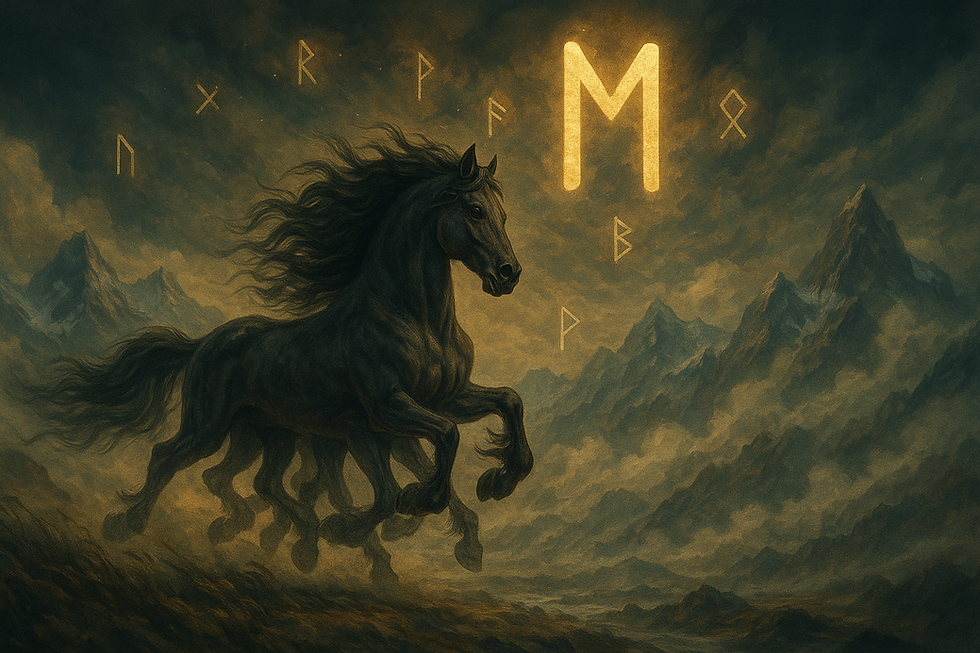
The Sacred Horse: In many cultures, the horse is seen as a sacred, magical creature that bridges the human world and the divine. Nowhere is this clearer than in Norse mythology with Odin’s steed Sleipnir. Sleipnir is perhaps the most famous horse in Norse myth – an eight-legged stallion, offspring of the trickster god Loki (in mare form) and a powerful stallion. Odin rides Sleipnir across the sky and even into the underworld, essentially using the horse to travel between the Nine Worlds of Norse cosmology. Because Sleipnir could go anywhere, it symbolized the ultimate freedom of movement and the deep trust between rider and mount (Odin had to trust an unusual, monstrous horse to carry him safely). Many rune scholars directly link Ehwaz to Sleipnir’s concept: Ehwaz is the rune that “carries” you between realms, just as Sleipnir carries. In fact, one historical clue is that the Old Norse name for the World Tree, Yggdrasil, literally means “Odin’s horse” (“Ygg” = Odin, “drasil” = steed), implying that the cosmic tree itself was likened to a horse that Odin rides in his shamanic travels. This highlights how deeply the horse was interwoven with the idea of journeying and connecting worlds – a core aspect of Ehwaz.
The Divine Twins: Interestingly, horses are often associated with twin gods or spirits in Indo-European myth. For instance, the Ashvins (Horse-Twins) in Vedic mythology are twin horsemen gods of the dawn, and the Greek Dioscuri (Castor and Pollux) were twin heroes sometimes shown riding white steeds, helping sailors and travelers. In Germanic lore, Tacitus wrote about the Naharvali tribe worshiping a pair of young male gods called the Alcis, whom scholars suspect might be a Germanic version of the divine twins. Why does this matter for Ehwaz? Because Ehwaz’s symbol of two lines joined has long been seen as hinting at twinship and duality. In the Norse pantheon, the closest example of sacred twins are Freyja and Freyr – sister and brother, Vanir deities.
They’re not depicted as horses, but they are intimately connected siblings who bring prosperity and fertility. Freyja especially had a known affinity for horses; some sources note horses were among animals sacred to her (she also receives half of the warriors slain in battle – perhaps riding to her hall). The twin aspect comes into Ehwaz symbolically: two working as one. Whether it’s two horses, horse-and-rider, or twin deities, the power emerges from their unity. Many ancient societies saw twins as lucky or supernatural (because of their unique bond), and horses were likewise thought to have a foot in the spirit world (interpreting horse behavior was a form of divination in Germanic tribes). So Ehwaz kind of sits at the intersection: the luck of partnership (twins) and the transcendence of travel (horse).
Horse in Ritual and Life: Historically, horses were incredibly important to the peoples who used runes. The introduction of horseback riding and chariots literally expanded horizons – “an achievement that changed the world as fundamentally as controlling fire,” as one author puts it. Germanic peoples often buried high-status individuals with their horses, or at least their horse’s trappings, indicating they believed the horse would carry them into the afterlife (again reinforcing the horse as a psychopomp, a carrier of souls). One famous archaeological find is the Oseberg ship burial (Viking Age) which included remains of several horses, likely to accompany the buried women on their final journey. In the Norse rune poems, though Younger Futhark has no Ehwaz, we do see other references to horses: for example, the Norwegian Rune Poem for Ur mentions “dross comes from bad iron; the reindeer often races over the frozen snow” – not a horse, but shows how movement is valued; the poem for Raido (riding) explicitly talks about how “Riding is said to be the hardest for horses” (hinting at how important the rider-horse relationship is). The Anglo-Saxon Rune Poem we already looked at shows the horse as joy of princes and comfort to restless wanderers – which in a sense frames the horse as an antidote to lack of movement (restlessness). When you have a good horse (or Ehwaz energy), restlessness turns to exploration.
Archetypes: Ehwaz embodies a few archetypal images:
The Journeyer and Guide: Think of the hero with their trusty animal companion (a knight with a horse, a cowboy with a horse, or any adventurer with a loyal pet/friend). This archetype tells us no hero truly walks alone – their strength is often their bond with allies. Ehwaz is that story of synergy.
Yin and Yang / The Syzygy: Two halves making a whole. In psychological terms, one could see Ehwaz as representing the conscious self and the subconscious (or the ego and the “shadow”/animus as Jung might say) working in harmony. The horse might symbolize the instinctual, primal energy, while the rider is the rational direction. United, they achieve things neither could separately. This is similar to the concept of syzygy (a paired unity, like sun and moon, male and female principles working together).
The Pilgrim’s Trust: Another archetype is the pilgrim who trusts that the road (and perhaps the divine) will provide guidance and companions. Ehwaz appears in those moments where one must take a leap of faith that “the next step will appear” – often, someone shows up to help or the circumstances shift once you commit to the journey. It’s almost like the universe saying “Trust me, I’ll send a ride.”
The Loyal Friend/Ally: On a more everyday level, Ehwaz is the archetype of the loyal friend or sidekick in stories. Think Samwise Gamgee to Frodo, or Ron and Hermione to Harry, etc. They might not be the one in the spotlight, but without them the mission would fail. Ehwaz energy often operates somewhat quietly in the background – like a supportive friend – but is utterly crucial.
Symbolically, the imagery of two shows up strongly. The Ehwaz rune itself looks like ≈ an M or perhaps two Λ shapes joined. Some see it as two Laguz runes (ᛚ) mirrored and connected, which is poetic since Laguz is flow and intuition – two flows meeting. This could imply emotional attunement between partners. Others simply see it as two horse heads touching noses (as if greeting each other, a sign of trust). However you see it, that dual structure is unlike many other runes and visually reminds us of symmetry and partnership.
Finally, it’s worth noting that Ehwaz is in Tyr’s Ætt (the third family of runes). Tyr’s Ætt deals a lot with maturation, social relations, and transcendence. Tyr’s rune (ᛏ) is about duty and sacrifice, and other runes in this set include Mannaz (humankind) and Othala (heritage, community). Ehwaz fits in by highlighting the value of working together (society) to move forward, as opposed to individual might. It’s a more “civilized” concept compared to the survival themes of earlier runes. Some even call the third ætt the ætt of “Integration” – integrating the self with others and the divine. Ehwaz beautifully captures integration: rider with horse, self with other, material journey with spiritual journey.
In summary, the myths and symbols around Ehwaz teach us that progress is a collaborative venture – whether between mortal and beast, god and human, twin souls, or the different parts of one’s own being. The horse in myth carries heroes to their destiny, but only if the hero cares for and guides the horse; likewise, Ehwaz invites us to be both vulnerable (trusting another) and responsible (worthy of trust) on the road of life. It’s a rune that says magic happens when “two” move as one.
Dos and Don’ts with Ehwaz’s energy
To wrap up, here are some quick do’s and don’ts to honor the lessons of Ehwaz in your daily life and spiritual practice:
Do (✅) | Don’t (❌) |
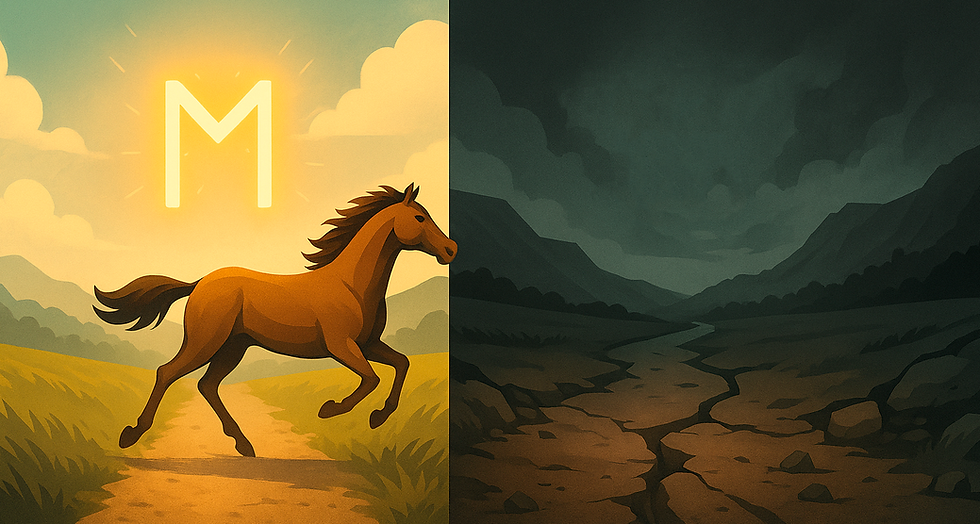
Do cultivate trust and clear communication in your relationships. Be honest, reliable, and open to listening, so that partnerships can thrive and move forward. | Don’t break trust or act deceitfully toward those who support you. Manipulation, lies, or inconsistency will derail the progress – Ehwaz’s energy shuts down when trust is violated. (A horse that is mistreated will refuse to run.) |
Do embrace collaboration and ask for help when needed. Recognize the power of teamwork – two people pooling strengths can accomplish more. Let others lend you a hand or advice; it’s not a sign of weakness but of wisdom. | Don’t insist on doing everything alone out of pride or fear. Isolation can lead to stagnation and burnout. Ehwaz teaches that going solo in all things is like trying to ride a one-wheeled chariot – why struggle unnecessarily? |
Do practice patience and steady effort. Pace yourself and those working with you. Sustainable progress (the “long trot”) wins out over sudden spurts and crashes. Celebrate small milestones on the journey. | Don’t rush headlong or force rapid change when conditions aren’t right. Impatience – like spurring a horse too hard – can cause accidents or burnout. Similarly, don’t drag others faster than they can handle; it breeds resentment and mistakes. |
Do show loyalty and support to your partners (friends, family, coworkers). Be the “trusted steed” for others when you can: keep confidences, do your share of the work, and encourage them on their path. Lead or follow as appropriate to maintain harmony. | Don’t abandon or undermine those who have been your allies. In challenging times, avoid the temptation to blame or escape. Ehwaz reminds us that enduring partnerships require commitment. Jumping ship or sabotaging the team effort not only hurts others, it leaves you without a ride forward. |
Do remain adaptable and open to new routes. If one path is blocked, Ehwaz’s wisdom is to find another way together. Stay flexible – maybe try a different approach or role swap (let someone else lead for a bit). Adaptation keeps you moving. | Don’t stubbornly stick to one plan or dominate the direction when it clearly isn’t working. Rigidity can stall the whole wagon. Also, don’t clench up with fear of change; trust that you and your “horse” can navigate detours. Remember, progress sometimes means adjusting course. |
In summary, Ehwaz’s energy is all about cooperative movement. By applying these do’s and don’ts, you align yourself with that energy: trusting, sharing the journey, and steadily advancing. When you honor partnerships – whether with other people, your community, or even the partnership between you and fate – you invoke the spirit of Ehwaz. And when you misuse trust or refuse to cooperate, Ehwaz withdraws, leaving the way forward heavy and hard. Keep this rune’s lessons in mind as you make decisions: am I working with the flow, with others, and with my own needs? If yes, you’re likely on the right track.
Following Ehwaz’s principles, you’ll find that doors open, allies appear, and progress happens naturally. It’s like having a loyal horse carrying you – treat it well, and it will take you wherever you need to go.
FAQ about the Ehwaz rune
What does the Ehwaz rune symbolize?
Ehwaz (ᛖ) literally means “horse” in Proto-Germanic, and by extension it symbolizes movement, progress, and partnership. Think of how a horse enables a rider to travel farther and faster – Ehwaz represents the idea that working together or having a trusty “vehicle” can carry you forward. Key themes of Ehwaz include trust, loyalty, and cooperation (like the bond between a horse and rider) and steady forward motion toward a goal. It’s not a rune of sudden change, but of gradual, reliable progress achieved through synergy. In readings, it often points to issues of partnership (in love, friendship, or business), any situation involving a journey or relocation, or the need for trust and teamwork to overcome obstacles. Historically, the horse was a sacred symbol of travel and was even seen as a link to the divine, so Ehwaz also has a subtle undertone of being guided or carried by spiritual forces when you’re on the right path. Summed up, Ehwaz is the rune of “the journey made better by a loyal companion” – it’s about how you get somewhere (with help, with unity) as much as where you’re going.
Is Ehwaz a “good” rune or a “bad” rune?
Ehwaz is generally considered a positive rune, especially when upright. There isn’t inherent “good/bad” in runes (they each cover a spectrum), but upright Ehwaz tends to indicate good news: things are moving forward, partners are trustworthy, and progress is being made. It’s often a reassuring sign that momentum will pick up or that you have the support you need. There’s very little “negative” about Ehwaz upright – even the challenges it brings are usually manageable through cooperation and patience.
When reversed, Ehwaz isn’t exactly “bad,” but it does warn of difficulties like delays, miscommunications, or trust issues. A reversed Ehwaz can feel frustrating: imagine a wagon stuck in mud or a partnership where the two people aren’t in sync. It suggests something is out of alignment and causing stagnation or back-and-forth conflict. However, even reversed Ehwaz isn’t catastrophic – it usually indicates a temporary block or a need to adjust, not permanent failure. For example, if you drew Ehwaz reversed regarding travel, it might mean “not yet, postpone” rather than “never.” If about a relationship, it signals problems that, with effort, could be resolved (unlike, say, a rune that indicates a final breakup).
So, in a nutshell: Ehwaz upright = positive cooperation and movement, Ehwaz reversed = frustrations, stagnation, or discord that need addressing. It’s much like getting feedback that you need to slow down and regroup. The rune itself isn’t “evil” or something; it’s showing you the state of the journey. Many readers find that even reversed Ehwaz has a hopeful angle – it implies the potential for progress is there, just not unlocked yet. Context (neighboring runes and the question asked) will give more detail on how serious the blockage is. But overall, Ehwaz is one of the more constructive runes: it encourages solving problems through trust and collaboration rather than indicating doom.
Which gods are associated with Ehwaz?
Ehwaz doesn’t have a direct, single deity attested in lore, but in modern rune practice it’s often linked to a few figures:
Freyja and Freyr: These twin Vanir deities are commonly associated with Ehwaz’s themes of partnership and fertility. Freyja (goddess of love, fertility, magic) and her brother Freyr (god of fertility, prosperity, fair weather) are a divine pair (twins) who balance each other. They’re not specifically horse-gods, but horses were sacred in many fertility cults and Freyr in particular had cult horses in some Norse traditions. Also, being twins, they embody that “two working as one” energy. Many rune authors assign Freyja/Freyr to Ehwaz because of the harmony and fruitful cooperation the rune represents. Invoking Freyja might bring blessings of love and trust; invoking Freyr could bring growth and smooth travels (Freyr had control over weather and the land’s peace – good for journeys).
Odin (via Sleipnir): Odin himself is linked to many runes, and Ehwaz can be connected to him through his steed Sleipnir. Sleipnir is not a god (it’s a mythological horse), but it’s so iconic that some practitioners honor Odin’s ability to travel through Sleipnir when working with Ehwaz. If you think of Ehwaz as “the horse rune,” Sleipnir is the uber-horse. Odin as the All-Father is also a god of journeys (he wanders the worlds) and of ecstatic trance (he “rides” in spirit), so there is a resonance. In practical terms, someone might pray to Odin to grant them a safe journey or to “ride with them” if they use Ehwaz in a travel talisman.
Nerthus or Epona: A couple of more obscure associations – Nerthus was an Earth goddess in early Germanic lore who had a sacred wagon pulled by cattle or horses; when she toured, peace reigned. While not commonly cited, the imagery of a deity whose sacred wagon is drawn by animals ties into the cooperative travel motif. Epona is a Celtic horse goddess (Romans also worshiped her) – not Norse, but sometimes people syncretize. Epona embodies the protective horse energy (especially for cavalry), so in a broad sense, Ehwaz could be placed under her patronage if one is inclined toward Celtic paganism or general horse symbolism.
That said, Ehwaz isn’t strongly “owned” by any single god the way, say, Thurisaz is very much Thor’s rune or Tyr’s rune is Tiwaz. It’s more about a concept that many deities participate in. In the rune poem, the horse is a joy “before princes” and “warriors”, implying nobility and warriors all valued horses – so you could say any god or goddess connected with horses or travel can be invoked. For example, some might toast Sigurd (Siegfried), a hero, and his horse Grani (in the Völsunga saga) as an embodiment of a warrior and steed partnership. Or even Skadi (goddess of winter and mountains) who at one point rides an eight-legged horse in myth. But these are deeper cuts.
In summary, Freyja and Freyr are the most commonly cited with Ehwaz (for partnership, fertility, harmonious teamwork). Odin (through Sleipnir) is also thematically appropriate, especially if your focus is shamanic journeying or need for guidance. If you’re exploring Ehwaz and you already have a patron deity, consider how that deity might relate: e.g., a modern practitioner might ask Archangel Raphael (guardian of travelers) to bless an Ehwaz charm, or ask Apollo (who had chariot horses pulling the sun) for clarity on a journey – whatever fits your spiritual framework. The rune will work regardless; the gods just add their flavor and support.
How do you pronounce “Ehwaz,” and what language is that from?
“Ehwaz” is typically pronounced as “EH-wahz” or “AY-wahz.” The first syllable is like the “eh” in “echo” (or a long “ay” sound as in “hay,” depending on accent), and the second syllable rhymes with “Oz.” In IPA, it’s often given as /ˈeɪ-wɑz/. You might also hear it said as just “eh-waz” with a short e. Both are acceptable; there’s some variation because we’re reconstructing an ancient word. The stress is usually on the first syllable: EH-waz.
The name comes from Proto-Germanic ehwaz, which is the scholarly reconstructed term meaning “horse.” Proto-Germanic is the ancestor language of Old Norse, Old English, German, etc., around the first few centuries CE. We reconstruct it because we don’t have written records of Proto-Germanic, but we can infer the word from later attested words: for example, Old English eoh (horse), Gothic aiƕs (horse, as a rune name likely), Latin equus (horse) – they all point back to an Indo-European root ekwo-, meaning horse. So “Ehwaz” is essentially our best guess of what the Germanic peoples called the “E” rune originally.
In the Anglo-Saxon Futhorc, the rune ᛖ was called Ēoh or Eh as mentioned. Old English eoh (with a long ē) meant “war-horse” specifically in some contexts. Interestingly, because Ēoh also meant “yew” for a different rune, some sources say the Anglo-Saxons might have just called the horse-rune Eh (short e) to differentiate.
If you’re reading about runes in an Old Norse context, note that the Younger Futhark didn’t have this rune, so there’s no Old Norse name for it. Sometimes people use the Old Norse word for horse “jór” or just call it Ehwaz anyway for convenience. But primarily, “Ehwaz” is a reconstructed Proto-Germanic name, and we say “EH-waz” for ease of modern discussion.
So, to recap: pronounce it like “EH-waz”, and know that the name is derived from ancient Germanic language for horse. If you hear someone say “ay-waz” or “ee-waz,” they might be mixing it with “Eihwaz” (a different rune – see the next question). The clear way is eh-waz.
How can I use the Ehwaz rune in practice for travel or partnership?
There are several practical ways to work with Ehwaz’s energy in your daily life or magical practice, especially if you want safe travels, smoother transitions, or improved partnerships. Here are a few approaches:
Travel Talismans: As mentioned earlier, creating a travel talisman with Ehwaz is popular. For example, draw or engrave ᛖ on a small object (a coin, a piece of wood, a stone) and keep it with you while traveling. You can keep it in your car for protection on road trips or in your suitcase for flights. Many people report feeling more secure with a rune like Ehwaz watching over their journey. To empower it, hold it and visualize a calm successful journey, maybe even see a horse guiding your vehicle. If you have a long commute daily, you could hang a tiny Ehwaz rune on your rearview mirror (just be safe it doesn’t obstruct view). Ehwaz will act as a subtle guardian, promoting cooperation (e.g. traffic flows without aggressive drivers) and warding off mishaps.
Partnership Blessings: If you want to strengthen a romantic relationship or friendship, you could do a simple ritual. One idea is to exchange objects marked with Ehwaz. For instance, each person takes a small stone and draws Ehwaz on it, then you swap stones – so you carry each other’s rune. This symbolizes trusting each other to “carry” one another. Another idea: Bake something like bread or cookies and mark an Ehwaz on it (icing, carving, etc) and share it with your partner – literally ingesting the symbol of unity and cooperation. Or more straightforward, both of you can jointly light a candle and say an intention while focusing on Ehwaz, asking for continued harmony and teamwork. The key with partnership magic is both parties ideally consenting or aware – doing it with your partner doubles the effect (very in line with Ehwaz!). If that’s not possible, you can still individually send positive energy – visualize both of you surrounded by the rune’s light, communicating openly and moving in sync. Important: Ehwaz should not be used to force someone’s feelings or choices (that’s manipulative magic). Use it to enhance existing bonds or clear obstacles between you.
Motivation and Breaking Stagnation: If you’re personally feeling stuck in some area (procrastinating, fearful of change, etc.), you can use Ehwaz to kickstart yourself. One simple trick: write down a goal or something you’re avoiding on a paper. Then draw Ehwaz next to it big and bold. Stick this paper somewhere visible (mirror, desk). Every day, touch the Ehwaz symbol and commit to one small action towards that goal. The presence of Ehwaz acts as a reminder that lots of small steps = a journey. It’s psychological but effective. Another approach: incorporate the rune into exercise or movement. For example, during a run or workout, chant “ehwaz” under your breath or in your mind, setting the intention that you are moving energy, not just your body. This can break internal inertia – you’re using physical momentum to create mental momentum, with Ehwaz as the bridge.
Rune Cast or Meditation for Guidance: If you’re unsure how to proceed in a situation (say you feel you need a change but don’t know where), try a rune casting specifically with Ehwaz’s help. Hold the rune set bag, speak “Ehwaz, guide me” (or similar) and draw a rune or two for insight. Alternately, do a meditation where you specifically ask, “What is the next step on my journey?” Imagine meeting a wise figure on horseback (maybe Odin on Sleipnir or a spirit guide) who gives you something or says something – that could be your answer. Writing afterward what happened can reveal surprisingly concrete advice.
Bindrunes & Spells: If you practice spellcraft, Ehwaz combines well with other runes in bindrunes for specific outcomes. For instance:
For a successful move to a new home, you might combine Ehwaz ᛖ + Othala ᛟ (home) + Raidho ᚱ, to ensure a smooth transition and settling.
For career advancement through teamwork, maybe Ehwaz ᛖ + Inguz ᛜ (fertility, project) + Ansuz ᚨ (communication) – meaning a collaborative project yields good results through clear communication.
For healing a troubled relationship, Ehwaz ᛖ + Gebo ᚷ + Laguz ᛚ could help emotional understanding flow again between two partners.
To do a bindrune: draw the runes in an overlapping design on paper or wood, focusing on each rune’s intent, then charge it (with a candle, breath, etc.) and keep it in a relevant place (under your mattress for relationship, on your workdesk for career, etc.).
Affirmations and Visualization: Simply affirming Ehwaz’s energy can be potent. Each morning, you might say: “I move forward with trust and cooperation. I invite helpful partnerships and steady progress into my life.” While saying it, you could trace the Ehwaz symbol in the air or over your heart. Visualization is another accessible tool: close your eyes and see yourself riding a horse confidently toward your goal, or imagine two horses pulling your chariot – one is you, one is all your support (friends, divine help, etc.), together they advance. Doing this regularly builds a mindset aligned with Ehwaz (confident, collaborative, optimistic about progress).
The key in all these methods is intention. Ehwaz will amplify and carry the intention you set, so be clear about what you want: “safe travel,” “improved trust,” “to get unstuck in job search,” etc. And because it’s a rune of partnership, it often asks you to do something in tandem: e.g., you carry the talisman and you drive safely; you do a ritual and you have a honest talk with your partner; you say an affirmation and you take a small action. Meet Ehwaz halfway, and it tends to give great results.


Comments